Vibe Coding Platforms Compared: Replit Agent vs Lovable vs Bolt.new vs v0.dev vs Cursor
This is a decisive moment for "vibe coding"—building software by describing what you want in natural language. By May 2026, the landscape has matured rapidly, but the five major platforms have diverged significantly in philosophy, feature set, and target user. Below is a comprehensive breakdown across all dimensions that matter for actual use.
---
1. Platform Overview and Positioning
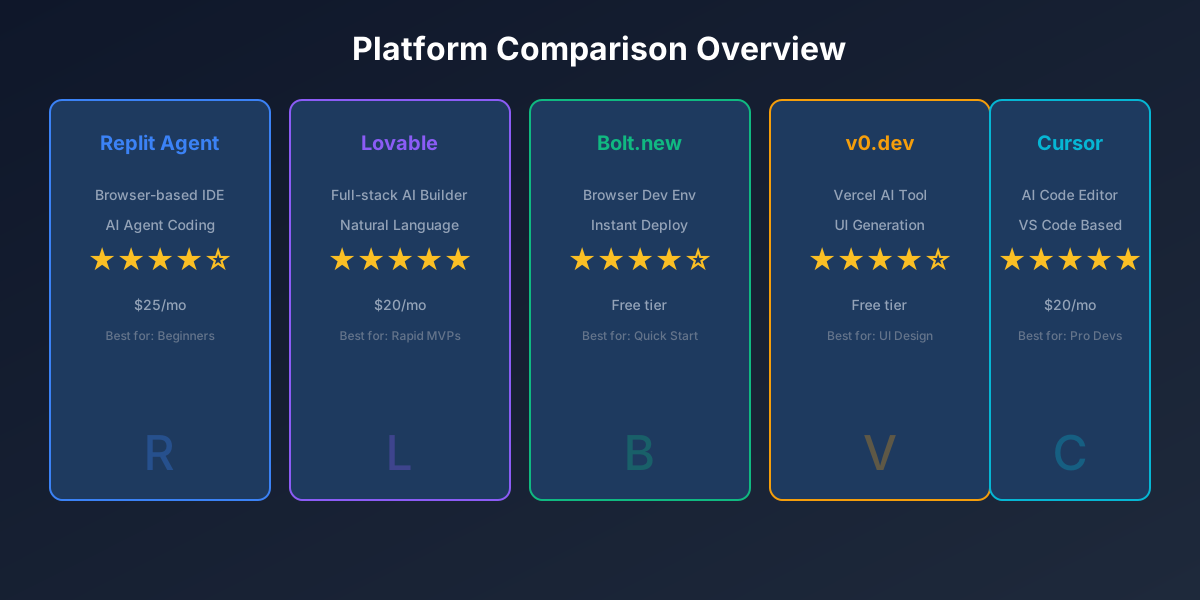
Replit Agent is a browser-based, all-in-one platform where the AI agent handles the full lifecycle—coding, debugging, testing, and deployment—inside a managed environment. It is the closest thing to a "one-button app factory" and is explicitly marketed toward non-developers and rapid prototypers who want production-ready results with zero setup 1(https://replit.com/products/agent)3(https://apps.microsoft.com/detail/9p9fxcgv0c9g)4(https://replit.com/). Founded long before the AI era (as Repl.it in 2016), it has the deepest legacy infrastructure 38(https://en.wikipedia.org/wiki/Replit).
Lovable is a Swedish startup founded in 2023 specifically for the vibe coding era 9(https://en.wikipedia.org/wiki/Lovable_(company)). It is a pure-play AI SaaS platform that generates web applications, internal tools, and websites from chat. It uses a multi-model backend (OpenAI, Google, Anthropic) rather than a proprietary model 12(https://lovable.click/). In December 2025, its cofounders were reported by Forbes to have become two of Europe's youngest-ever self-made billionaires 37(https://www.forbes.com/sites/aliciapark/2025/12/19/ai-startup-lovable-just-minted-one-of-europes-youngest-ever-self-made-billionaires/), reflecting explosive growth.
Bolt.new is an AI builder from StackBlitz (the team behind the online IDE of the same name). It is the least well-documented of the five due to severe name-collision issues in search (the same search terms return the Bolt mobility company, the Chevrolet Bolt, and other unrelated entities). What is known from its homepage is that it "automatically routes to the right model for each task, balancing quality and cost" 18(https://bolt.new/). It is positioned as a "write once, deploy everywhere" AI builder for websites, apps, and prototypes.
v0 (formerly v0.dev, now v0.app) is Vercel's AI-powered application builder. It launched in October 2023 as an experimental UI component playground and has since undergone a major rebrand (January 2026) into a full-stack application builder 22(https://www.taskade.com/blog/v0-review). It won a 2025 Webby Award for developer tools 23(https://en.wikipedia.org/wiki/Vercel). v0 generates React and Next.js code with shadcn/ui components and is deeply integrated into the Vercel ecosystem. An iOS app was also released, allowing building on mobile 29(https://v0.app/).
Cursor is unique in this group: it is not a browser-based platform but an AI-first fork of VS Code (by Anysphere). It functions as a local IDE with powerful agentic features. It requires the user to have a development environment set up and is aimed squarely at developers who want AI assistance within their existing workflow, rather than at non-coders trying to avoid touching code entirely.
---
2. Core Features and AI Capabilities
Natural Language to Code Workflow
Replit Agent is designed to be the most "hands-off" experience. You describe your app in plain English, and the agent builds it with auth, database, security, testing, and publishing all built in 3(https://apps.microsoft.com/detail/9p9fxcgv0c9g). The platform acknowledges that the agent's behavior is "probabilistic" and may occasionally make mistakes 2(https://replit.com/pricing).
Lovable similarly allows you to "build apps, websites, and digital products faster using Lovable's no-code and AI-powered platform, no deep coding skills required" 11(https://lovable.dev/). A key differentiator is its multi-model approach—it uses OpenAI, Google, and Anthropic models, which may give it flexibility in handling different types of tasks 12(https://lovable.click/).
Bolt.new's standout claim is automatic model routing: "Bolt automatically routes to the right model for each task, balancing quality and cost. No more juggling models or prompting multiple AIs" 18(https://bolt.new/). This is a meaningful feature if it works well—users of other platforms often find themselves switching between models for different parts of a project.
v0 has evolved from "generate a React component" to "design, iterate, and scale full-stack applications" 29(https://v0.app/). Its tight integration with the Vercel platform means it understands deployment, serverless functions, and the modern web stack natively. It generates "copy-and-paste friendly React code based on simple text prompts, leveraging the power of shadcn/ui" 27(https://easywithai.com/ai-developer-tools/v0-dev/).
Cursor offers the most granular developer control. Its Agent mode can plan and execute multi-step tasks (e.g., "build a full-stack app with authentication and a PostgreSQL database"), while its Composer handles multi-file edits, Tab provides AI autocomplete, and Ctrl+K enables inline editing. It supports all VS Code extensions, giving it the richest ecosystem of any platform here.
Code Quality and Correctness
The most directly relevant comparison comes from a March 31, 2026 XDA Developers article that tested Replit, Lovable, and Claude Code building the same application 16(https://www.xda-developers.com/tried-replit-lovable-and-claude-to-build-the-same-app/). While the full article text was not retrieved, the available snippet reveals a critical finding: for a CSV parsing task, both Replit and Lovable required the user to go in and follow up with additional prompts just to get them to parse the CSV correctly, while Claude's version handled it perfectly on the first go 16(https://www.xda-developers.com/tried-replit-lovable-and-claude-to-build-the-same-app/). This suggests that for data-sensitive tasks, the AI agents on Replit and Lovable may produce code that looks right but has subtle bugs, requiring more debugging iteration from the user.
This aligns with Replit's own acknowledgment that its agent's behavior is "probabilistic" 2(https://replit.com/pricing). For simple, well-defined tasks, the agents work well; for tasks requiring precise data handling or complex logic, you may need to intervene.
Cursor, because it runs on your local machine and can leverage more powerful models (including Claude Opus, GPT-4, etc.), generally produces higher-quality code for complex tasks. However, this comes at the cost of setup complexity and the need for a local development environment.
v0's code quality benefits from being tightly scoped to the Vercel/Next.js ecosystem—it generates production-tested patterns that the Vercel team has validated, which reduces the likelihood of subtle bugs in typical web application patterns.
---
3. Pricing
Pricing remains one of the most opaque areas, varying significantly by platform.
Replit Agent uses an effort-based credit system. An October 2025 analysis on Superblocks found that pricing can be "unpredictable" because it depends on how much work the agent does per task 42(https://www.superblocks.com/blog/replit-pricing). Plans include a free tier with limited credits, paid plans (often cited as Core and Pro tiers), and likely an enterprise tier. The exact dollar amounts depend on the region and plan, but users should expect costs to scale with the complexity and number of iterations.
Lovable maintains a transparent pricing page at lovable.dev/pricing with plans for individuals and teams 15(https://lovable.dev/pricing). Specific tier prices were not retrieved, but the structure is designed for users building apps, internal tools, and prototypes.
Bolt.new pricing was not retrievable from the available sources.
v0 (Vercel) offers Free, Pro, and Enterprise tiers 30(https://www.nxcode.io/resources/news/v0-by-vercel-complete-guide-2026). The Free tier is generous for experimentation (limited generations), while Pro unlocks higher limits and priority access. Enterprise includes custom deployment options and dedicated support.
Cursor has clear pricing: a Free tier with limited usage, Pro at $20/month (which includes unlimited AI completions, agent mode, and all features), and Business at $40/user/month with centralized billing and admin controls. This is among the most transparent and competitive pricing models in the category.
---
4. Supported Languages, Frameworks, and Tech Stacks
Replit Agent is the most language-agnostic, though it particularly markets its Python capabilities 6(https://replit.com/languages/python3). It supports multiple languages but the exact list was not enumerated.
v0 is the most opinionated and focused—it is built around React, Next.js, and shadcn/ui. This is an advantage if you are building a modern web app (the quality is high for that use case) but a limitation if you want Python, a different framework, or a non-web application.
Cursor supports any language that VS Code supports, which is effectively every major programming language. It is the most flexible option but requires the user to set up the environment.
---
5. Integration Capabilities
Version Control
Replit Agent and Lovable both have version history built into their platforms (you can roll back to previous states), but they do not offer native Git integration in the way Cursor does. Cursor has full VS Code Git integration—commit, push, pull, branch management, and diff viewing are all native. v0 generates code that you can copy into a Git-managed project. Bolt.new's version control capabilities are not documented.
Third-Party APIs and Databases
Replit Agent has built-in auth, database, security, testing, and publishing 3(https://apps.microsoft.com/detail/9p9fxcgv0c9g). This is a significant advantage for non-developers—you don't need to set up a separate database or authentication provider. Lovable provides enterprise-grade hosting 13(https://www.lovableai.io/features). v0 works with Vercel Postgres, Edge Config, and the broader Vercel ecosystem. Cursor relies on the user to configure all external services.
Deployment
Replit Agent's one-click deployment is the standout feature here. You build and deploy from the same environment. v0 offers one-click deployment to Vercel (which includes custom domains, serverless functions, and edge caching). Lovable provides enterprise-grade hosting. Cursor requires manual deployment (or integration with deployment scripts).
---
6. Community, Documentation, and Learning Resources
Replit Agent has the most mature ecosystem, with courses, tutorials, and lessons available through its support center 8(https://support.replit.com/hc/en-us). It is "trusted by" a large user base built up over nearly a decade 3(https://apps.microsoft.com/detail/9p9fxcgv0c9g). A desktop app is available for a native experience 7(https://replit.com/desktop).
Lovable has a growing community, a YouTube channel showcasing builds 14(https://www.youtube.com/@LOVABLE), and third-party guides (e.g., lovableai.io) offering feature guides. Its community is newer but growing fast, fueled by the Forbes attention.
v0 benefits from Vercel's large developer community and extensive documentation. The Vercel ecosystem is well-documented, and v0 builds on that.
Cursor has a strong following among professional developers, with extensive community discussions on Reddit, Hacker News, and Twitter/X. Its documentation is thorough, and it supports all VS Code extensions, giving it the largest ecosystem of any platform here.
Bolt.new has the weakest documentation and community presence in the available sources, though this may partly be a search-indexing issue.
---
7. Recent Developments (2025–2026)
Several major developments differentiate these platforms going into mid-2026:
- Replit + Visa (May 2026): Visa announced an undisclosed investment in Replit, and the two companies are exploring how to integrate Visa's payment products into Replit so developers can build payment-enabled applications more easily 40(https://techcrunch.com/2026/05/28/visa-invests-in-replit-to-power-agentic-payments-for-developers/)41(https://www.prnewswire.com/news-releases/replit-expands-enterprise-leadership-with-visa-investment-and-partnership-payments-expansion-and-solution-partner-program-302784366.html). This is a significant enterprise play.
- Lovable's Billionaire Status (December 2025): Lovable's cofounders were reported as billionaires, signaling massive market validation and likely leading to accelerated investment in the platform 37(https://www.forbes.com/sites/aliciapark/2025/12/19/ai-startup-lovable-just-minted-one-of-europes-youngest-ever-self-made-billionaires/).
- v0 Rebrand and Full-Stack Evolution (January 2026): v0.dev became v0.app, reflecting its shift from a UI component playground to a full-stack application builder. An iOS app was also released 22(https://www.taskade.com/blog/v0-review)29(https://v0.app/).
- Cursor's Continued Growth: Cursor has become the default AI coding assistant for many professional developers, with its Agent mode being a key differentiator. The company (Anysphere) raised significant funding at a ~$400M valuation.
- Bolt.new's Positioning: Remains somewhat of a dark horse, with its automatic model routing being a potentially unique differentiator, but lacking the public visibility of the other platforms.
---
8. Strengths, Weaknesses, and Best-Use Cases
Replit Agent
Best for: Non-developers and rapid prototypers who want to build and deploy a complete application (with auth, database, and hosting) from a single prompt without touching any infrastructure. Ideal for MVPs, internal tools, and learning to code.
Strengths: Zero-setup environment; built-in auth, database, deployment; all-in-one platform from idea to live app; large community and learning resources.
Weaknesses: Code quality may require iteration (especially for data-sensitive tasks) 16(https://www.xda-developers.com/tried-replit-lovable-and-claude-to-build-the-same-app/); proprietary model limits model choice; credit-based pricing can be unpredictable 42(https://www.superblocks.com/blog/replit-pricing).
Lovable
Best for: Users who want a multi-model AI approach and a polished, modern UX for building web applications and internal tools. Strong for startups and founders who want to rapidly prototype and validate ideas.
Strengths: Uses best-in-class models (OpenAI, Google, Anthropic); strong investor backing and rapid development; enterprise-grade hosting; well-funded and growing fast.
Weaknesses: Newer platform with less mature documentation than Replit; may require follow-up prompts for complex logic 16(https://www.xda-developers.com/tried-replit-lovable-and-claude-to-build-the-same-app/); community still developing.
Bolt.new
Best for: Users who want the "best model for each task" handled automatically, without having to decide which AI to use for which part of their project.
Strengths: Automatic model routing could save significant time and improve quality; built by StackBlitz (experienced in online development environments).
Weaknesses: Severely under-documented in the public record; unclear pricing, frameworks, and capabilities; very difficult to find user reviews or benchmarks.
v0 (Vercel)
Best for: Developers building React/Next.js applications who want AI-generated, production-quality UI components and full-stack applications with one-click Vercel deployment. Ideal for founders and teams already in the Vercel ecosystem.
Strengths: Highest quality output for its opinionated stack (React/Next.js/shadcn/ui); tight Vercel integration (deployment, serverless, Postgres, analytics); Webby Award winner; iOS app for mobile building; proven in production use.
Weaknesses: Limited to the Vercel/Next.js ecosystem; not suitable for Python, non-web apps, or other frameworks; requires some familiarity with React/Next.js to customize output.
Cursor
Best for: Professional developers who want AI-powered coding assistance within their existing workflow and are building production applications across any stack. The power-user's choice for vibe coding.
Strengths: Full VS Code ecosystem (extensions, themes, Git integration); supports any language and framework; Agent mode for complex multi-step tasks; highest code quality for complex projects; clear and competitive pricing ($20/mo Pro); local execution for data privacy.
Weaknesses: Requires local development environment setup; not truly "no-code"—you need to understand the code it generates; no built-in deployment; higher learning curve for non-developers.
---
9. Final Verdict: Which Platform Wins in 2026?
There is no single "best" platform—the right choice depends entirely on who you are and what you are building.
For non-developers who want a complete, deployed app with zero setup: Replit Agent is the strongest choice. Its built-in auth, database, and one-click deployment mean you can go from idea to live URL in minutes. Lovable is a strong alternative with a multi-model backend.
For founders and teams building React/Next.js applications with production-quality UI: v0 is the clear winner. The quality of its generated components (especially with shadcn/ui) and the seamless Vercel deployment pipeline make it the most efficient choice for modern web applications.
For professional developers who want AI assistance across any stack: Cursor is the undisputed best-in-class. Its Agent mode, Composer, and deep VS Code integration provide the most powerful and flexible AI coding experience. If you already know how to code, Cursor will make you dramatically faster.
For users who want the best AI model selected automatically: Bolt.new has a unique value proposition with its automatic model routing, but the lack of public information makes it a riskier choice until more documentation and reviews emerge.
For data-intensive or complex logic applications: None of the vibe coding platforms are fully reliable yet. The XDA comparison found that both Replit and Lovable required iteration for CSV parsing, while Claude Code (which Cursor can leverage) handled it correctly on the first attempt 16(https://www.xda-developers.com/tried-replit-lovable-and-claude-to-build-the-same-app/). For complex logic, either use Cursor with a strong model or be prepared to debug the output from any browser-based platform.
Ranked by Use Case
The vibe coding landscape in 2026 is vibrant but still maturing. The browser-based platforms (Replit, Lovable, v0, Bolt.new) excel at rapid prototyping and lowering the barrier to entry. Cursor excels at professional development productivity. For most users, the best approach is to use a combination—v0 or Replit for quick prototypes and UI, Cursor for serious development work. The platforms are converging toward each other (v0 is adding full-stack capabilities, Cursor is adding agentic multi-step planning), so the decision in 2026 often comes down to ecosystem preference and whether you want to work in a browser or in a local IDE.