AI-Powered Writing & Editing Tools for Academic Papers
The academic writing assistant landscape in 2026 has matured significantly, with tools evolving beyond basic grammar checking into full-spectrum writing companions that understand academic context, citation formatting, and discipline-specific conventions.
Grammarly remains a dominant force, offering a free tier that handles basic grammar, clarity, and tone, alongside premium tiers that include plagiarism detection against ProQuest's database and billions of web pages 101102103. Its Chrome extension provides real-time suggestions across documents, emails, and web forms. However, Grammarly's academic-specific capabilities — such as citation generation in APA, MLA, and Chicago styles — are now complemented by competitors that offer deeper domain specialization 100.
Paperpal has emerged as perhaps the strongest dedicated academic writing assistant in 2026. Built by Cactus Communications with 22+ years of science, technical, and medical publishing expertise, Paperpal is trained on millions of published research articles and understands academic context deeply — it suggests precise language corrections without altering references, equations, or technical terms 173178. Often described as "Grammarly, but with a PhD" 179, it offers real-time language editing, grammar checking, plagiarism detection, and similarity scoring with color-coded results and side-by-side comparisons 177178. Paperpal costs $25/month and is designed to support authors from first draft to final submission, making it particularly valuable for graduate students and researchers preparing manuscripts for publication 173174.
QuillBot continues to be a versatile tool for students, offering a suite that includes paraphrasing, grammar checking, tone analysis, and fluency improvement 122123. Its strength lies in helping non-native English writers rephrase and refine their academic prose. QuillBot integrates as a Chrome extension and Windows app, working directly where users write 124162. An in-depth January 2026 review covers its paraphraser, grammar checker, pricing, and key limitations 126.
ProWritingAid positions itself as a tool for serious writers, offering color-coded underlines for grammar, style, and spelling issues with one-click resolutions 156. A 2026 comparison review notes it stands out for fiction and non-fiction writers 158. While not as academic-specific as Paperpal, its detailed style analysis is valuable for dissertation and thesis writing.
Jasper AI, originally a marketing-focused tool, has not developed significant academic-specific features and is not recommended for students seeking dedicated academic writing support 163.
AI for Literature Review & Research Discovery
The 2026 landscape for literature review tools is rich and diverse, with platforms that go far beyond simple keyword search to offer semantic understanding, citation context analysis, and interactive research mapping.
Semantic Scholar serves as a foundational free research graph indexing hundreds of millions of papers across all fields of science. Its AI extracts meaning from paper text, enabling features like TL;DR summaries, citation graphs, and related paper recommendations 3. It is a free starting point for any literature search.
Elicit is used by over 2 million researchers and allows users to ask research questions in natural language, then searches over 125 million papers to extract key details into customizable tables 1. It is particularly strong for automating the screening and data extraction phases of systematic literature reviews, saving enormous time in the early stages of research.
Consensus addresses a specific pain point: determining the state of evidence on a research question. Users ask a clear yes-or-no question, and the Consensus Meter instantly shows how much the evidence agrees or disagrees, providing a fast visual read on scientific agreement or disagreement 2. This is invaluable for quickly gauging consensus on contested topics.
SciSpace has grown to support over 280 million papers and is trusted by over 1 million students, PhDs, and researchers 4. It is attempting to be the most comprehensive all-in-one research platform, combining literature search, PDF chat, paper summarization, AI detection, citation generation, and academic writing support 5630. A May 2026 review notes that SciSpace simplifies scientific papers, literature reviews, citations, and academic writing for students 8. Its PDF chat feature allows users to ask questions about any uploaded document and receive research-backed explanations 149.
Scite provides Smart Citations that classify whether a citation supports or contradicts a claim, backed by over 1.6 billion classified citation statements as of 2026 913. This is a game-changer for evaluating the reliability of scientific claims — instead of just counting citations, researchers can see whether a paper's findings have been supported or contradicted by subsequent work. Scite offers browser extensions for Chrome, Firefox, and Safari, making it easy to check citation context while reading anywhere online 14.
ResearchRabbit is often called the "Spotify for Papers" because it creates personalized, interactive maps of recommended papers based on user collections 16. It allows users to find related papers, build citation maps, and track research trends, powered by AI 17. Its visual, interactive approach makes literature exploration more intuitive and serendipitous.
Litmaps accelerates the literature review process by creating dynamic visualizations of the scientific literature landscape 21. Users enter a topic and Litmaps generates interactive literature maps — collections of articles that make up different research topics 22. It automates literature discovery by finding the most relevant articles using citation networks, with advanced search features and targeted functionality 24. Princeton University Libraries have cited Litmaps as a literature mapping tool 23.
Scholarcy is designed to improve reading efficiency by breaking down research into clear, bite-sized summary flashcards 2526. Its structured, predictable format supports students with dyslexia, ADHD, and autism 26. Scholarcy claims to save up to 70% of the time needed to extract key information from an article, making it ideal for literature screening 27.
A typical 2026 literature review workflow might involve: using Semantic Scholar or Elicit for initial discovery, Consensus for gauging evidence, Scite for verifying claims and citation contexts, ResearchRabbit or Litmaps for mapping the citation network, and Scholarcy or SciSpace for summarizing individual papers.
AI Assistants for Data Analysis & Coding
AI tools for data analysis and coding have become indispensable for students conducting quantitative research, with options ranging from no-code analysis platforms to intelligent code assistants.
ChatGPT and Claude serve as general-purpose coding assistants for academic research. Students use them to generate code for statistical tests (t-tests, ANOVA, regression, chi-square) in Python (using SciPy, StatsModels, Pingouin) and R, dramatically reducing time spent on syntax lookup and debugging. ChatGPT's code interpreter (advanced data analysis) feature allows users to upload data files and perform analysis through natural language prompts, generating visualizations and statistical outputs directly within the chat interface 139. Claude 5, described as "The Most Advanced AI Assistant in 2026," offers features like Projects for organizing research into workspaces, Artifacts for viewing and editing code in a separate window, and Extended Thinking for complex reasoning tasks — all accessible with a free account 187188189.
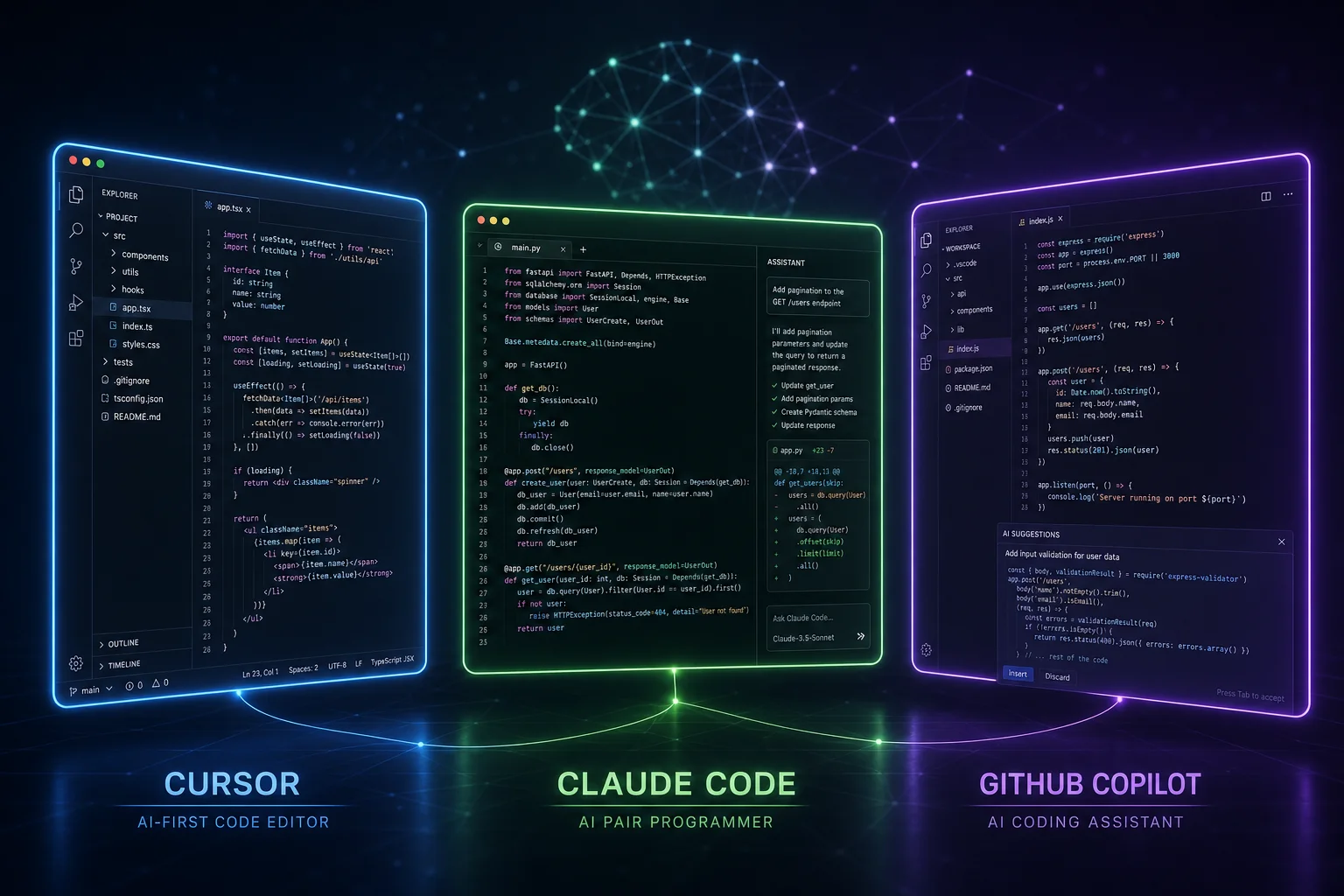
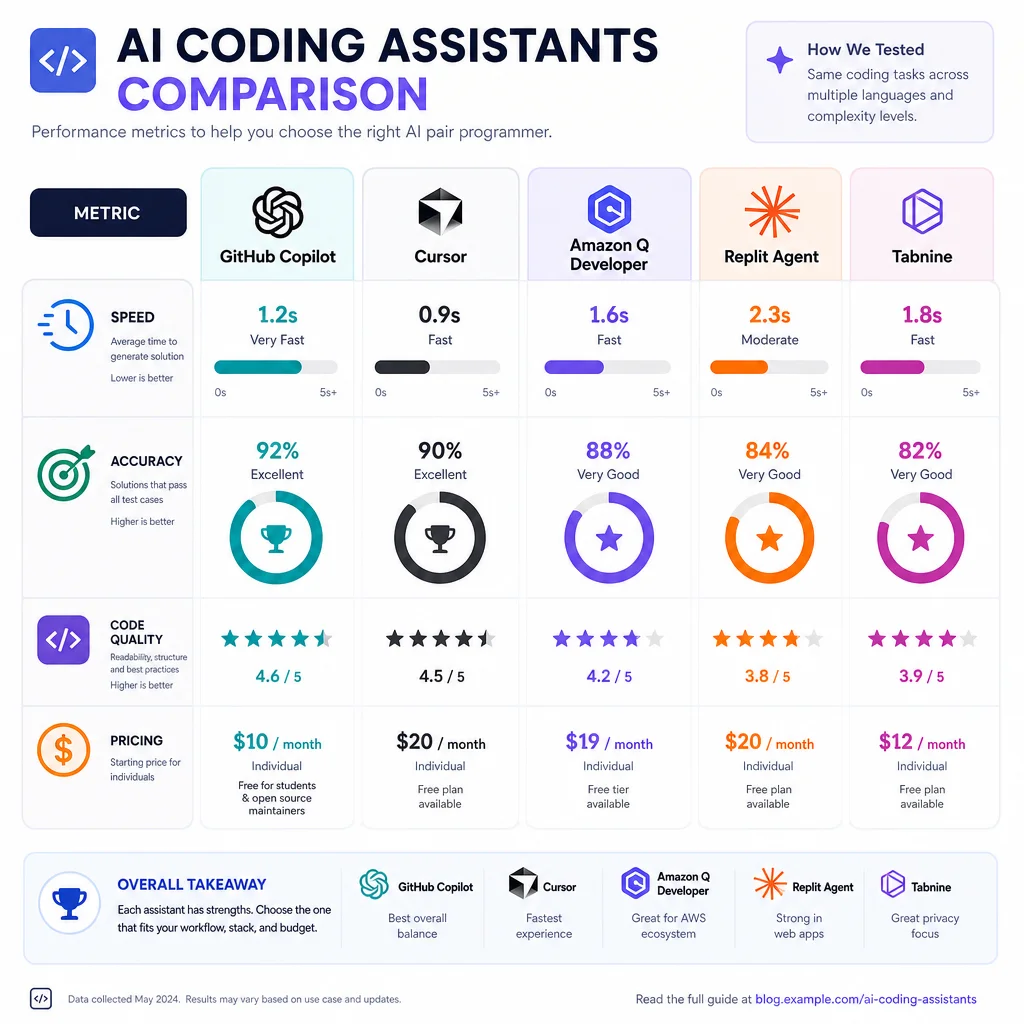
GitHub Copilot integrates directly with IDEs like VS Code, Jupyter Notebooks, PyCharm, and RStudio, providing real-time AI-powered code suggestions as researchers type 190. It functions as a pair programmer that anticipates the next lines of code based on comments and existing context. A major advantage for students: GitHub Copilot is free for verified students through the GitHub Education program, making it the most accessible premium coding assistant for academic researchers.
Windsurf (formerly Codeium, rebranded in late 2024) has emerged as the strongest free alternative to GitHub Copilot 191192. It offers a "free forever for individuals" tier with unlimited code completions, in-IDE chat, and support for 70+ programming languages 194195. This makes it particularly attractive for students who cannot access GitHub Copilot's free education tier or who need unlimited completions without usage caps.
Tabnine prioritizes privacy and enterprise compliance, offering air-gapped deployment, zero code retention, and triple-layer data protection 197198. For academic researchers working with sensitive or unpublished data, Tabnine's privacy-first approach is compelling. It offers whole-line and full-function code completions tailored to individual coding patterns and learns from a team's unique codebase 199200. Tabnine's 2026 plans include a free tier with usage limits, a Dev plan, and an Enterprise plan with self-hosted options 202.
Julius AI positions itself as a data analysis tool for non-technical users and researchers who want to interact with their data conversationally 182. Users connect spreadsheets and databases, ask questions in plain English, and receive charts and insights instantly without writing code manually 182. This is ideal for students who need quick data exploration and visualization without deep programming knowledge.
AI Study Aids
The 2026 ecosystem of AI study aids spans intelligent flashcard systems, automated note-taking, and personalized tutoring.
Anki remains the gold standard for spaced repetition flashcards. It is free and open-source, operates on the principles of spaced repetition and active recall, and guarantees users will remember material with minimal effort 3132. Its open-source nature means a vast library of shared decks and community-developed add-ons. The official iOS app (AnkiMobile) is paid, but the desktop and Android versions are free 3334.
RemNote has emerged as perhaps the most innovative AI study tool in 2026. It integrates powerful note-taking with flashcards and spaced repetition in a single platform 3537. Users can upload PDFs, videos, or notes and instantly generate AI flashcards, quizzes, summaries, and explanations 36. A 2026 review described it as "The AI Study Tool That Surprised Me Most," tested by creating flashcards and quizzes from uploaded files and recorded lectures 40. Version 1.20 featured a new Phone App, Text Reader, Lightning Editor Engine, and Translations 39. It is particularly well-suited for students, researchers, and knowledge workers who value deep connections between ideas 38.
Quizlet continues as a popular flashcard platform, allowing users to create their own cards or access millions of pre-existing decks created by students and teachers for any subject 41.
Khanmigo, Khan Academy's AI-powered personal tutor, uses Socratic questioning to guide students through problems rather than giving direct answers 4849. Priced at just $4 per month for families, it is significantly cheaper than alternatives 49. A CBS News 60 Minutes segment featured Khanmigo as an AI-powered online tutor that could change the way teachers work and students learn 51. However, a LinkedIn article from April 2026 provocatively claimed "RIP Khanmigo & Edtech Industry Dreams of AI Tutors," suggesting ongoing challenges in the edtech AI space 53. Despite this, Khanmigo remains a noteworthy option for its pedagogical approach and affordability.
Wolfram Alpha remains the definitive computational intelligence answer engine for math, science, engineering, and other quantitative disciplines, relied on by millions of students and professionals 5556.
Photomath solves math problems from photos instantly with step-by-step solutions, using Math AI technology to handle algebra, calculus, geometry, and more 575859. It is accessible online for free and supports instant scanning and solution generation 6061.
Socratic by Google provides visual explanations of important concepts across subjects, offering expert-created study guides, videos, and step-by-step explanations 6263.
For note-taking, Otter.ai provides AI transcription and insights for lectures and meetings, with flexible recording options across desktop, mobile, and browser 42. Mem positions itself as "Your AI Thought Partner," a notes app that automatically remembers, organizes, and surfaces information from user-created notes 46. Fireflies.ai transcribes meetings in multiple languages with industry-leading accuracy and speaker identification 47.
Citation Management, Plagiarism Detection & Academic Integrity
Zotero remains the gold standard for citation management in 2026, particularly because it is free, open-source, and recommended by Harvard Library and other major academic institutions 7071. It supports over 9,000 citation styles including APA, MLA, Chicago, and Harvard, and integrates with Word, LibreOffice, and Google Docs 6768. The Zotero Connector browser extension automatically senses content as users browse the web and allows one-click saving of citation information from websites, library catalogs, and other online sources 6972. It automatically extracts citation information, functioning as a smart collection tool 71.
Mendeley (by Elsevier) is a free all-in-one reference manager that stores, organizes, notes, shares, and cites references and research data 7475. It also functions as an academic social network connecting over six million researchers 7680. Note that Mendeley Desktop has reached end of life and has been superseded by Mendeley Reference Manager 79.
EndNote has been the world's leading reference management software for decades, and EndNote 2025 introduced groundbreaking AI-powered features and productivity enhancements 81. EndNote 21, available as of February 2026, simplifies collecting, organizing, and formatting citations 82. It integrates with Microsoft Word for bibliography creation 8485.
Paperpile offers web-based reference management with special emphasis on integration with Google Docs and Google Scholar 878889. It is designed as a modern reference manager for collecting, organizing, and formatting citations, particularly suited for researchers who work extensively in Google Docs 88.
Turnitin leads academic integrity and AI writing detection. Its AI writing detection capabilities have been enabled by 98% of its customers and have been independently shown to have high effectiveness in correctly identifying AI-generated text 108109. Turnitin operates under a philosophy of human-centered AI 110. A March 2026 guide explains how to interpret Turnitin similarity percentages 112.
Copyscape is an online plagiarism detection service launched in 2004 that checks whether text content appears elsewhere on the web, scanning billions of web pages 115116117. It is trusted worldwide for checking the originality of web content, including AI-generated text 118. However, it is primarily designed for web content and may not have the same academic database coverage as Turnitin.
Scribbr offers a free citation generator for APA, MLA, Chicago, Harvard, and other styles, verified by experts 93949596. Its Chrome extension instantly generates accurate citations for online sources and extracts key sentences 97. Scribbr's AI Detector can identify AI-generated content from ChatGPT, Copilot, and Gemini for free, with independent 2026 testing examining its reliability and false positive rates compared to Turnitin 9899.
Grammarly's plagiarism checker scans against ProQuest's database and billions of web pages, while its citation machine covers APA, MLA, and Chicago styles 100103.
All-in-One Platforms vs. Specialized Tools
A key decision for students in 2026 is whether to use general-purpose AI platforms or specialized academic tools.
General-purpose platforms offer breadth and convenience:
- ChatGPT serves as a general conversational AI assistant for exploring ideas, solving problems, coding, data analysis, and learning faster — all in one interface 138(https://en.wikipedia.org/wiki/ChatGPT)141(https://chatgpt.com/). Its code interpreter feature enables data analysis within the chat. However, it lacks the deep academic paper coverage and specialized features of dedicated research tools.
- Perplexity AI positions itself as a credible, up-to-date answer engine with deep research capabilities that synthesize information from multiple sources with citations 134(https://www.perplexity.ai/)136(https://apps.microsoft.com/detail/xp8jnqfbqh6pvf). A PC Mag article from April 2026 explored whether Perplexity could replace Google Search for research 137(https://www.pcmag.com/explainers/is-perplexity-better-than-google-search-i-switched-for-a-week-to-find-out). Its Deep Research feature guides users through multi-step AI-driven investigation 136(https://apps.microsoft.com/detail/xp8jnqfbqh6pvf).
- Notion AI combines note-taking, task management, and database functionalities with AI writing assistance in a single workspace 43(https://en.wikipedia.org/wiki/Notion_(productivity_software))44(https://thenotionbase.com/how-to-use-notion). A 2026 review from TheBusinessDive covers features, pros, and cons after two years of use 45(https://thebusinessdive.com/notion-review). It is powerful for organizing research projects but lacks academic-specific features like citation management or literature search.
- Google Gemini 3.5 (via Google DeepMind) combines frontier intelligence with action capabilities, built to execute complex, multi-step workflows 146(https://deepmind.google/models/gemini/).
Specialized academic tools offer depth and domain-specific features:
- SciSpace is attempting to be the most comprehensive all-in-one academic platform, combining literature search (280M+ papers), PDF chat, summarization, AI detection, citation generation, and writing support 4(https://scispace.com/)5(https://www.positioniseverything.net/scispace-software-review-pricing-features/)6(https://aichief.com/ai-text-tools/scispace/)30(https://aitoolsexplorer.com/ai-tools/scispace-ai-research-platform/).
- Elicit excels at early-stage discovery and structured data extraction from papers 1(https://elicit.com/).
- Consensus is best for gauging scientific agreement/disagreement on a question 2(https://consensus.app/).
- Scite is unparalleled for citation context analysis and claim verification 9(https://scite.ai/)13(https://comparateur-ia.com/avis/scite).
- ResearchRabbit and Litmaps lead in visual literature mapping 16(https://ai-tool.ai/tool/research-rabbit)17(https://www.researchrabbit.ai/)21(https://www.litmaps.com/).
- Paperpal provides the deepest academic writing support 173(https://manusights.com/blog/is-paperpal-worth-it)178(https://www.aixelerate.com/ai-tools/paperpal/).
The general recommendation for 2026 is a hybrid approach: use a general-purpose platform like ChatGPT or Perplexity for broad exploration and quick synthesis, then layer on specialized tools for specific research tasks — SciSpace or Zotero for literature management, Paperpal for writing polish, Scite for citation verification, and RemNote or Anki for study and retention.
Emerging Trends & New Entrants in 2026
Several key trends shape the 2026 landscape:
Consolidation of research workflows into single platforms. SciSpace exemplifies this trend, combining literature search, reading, writing, citation management, and AI detection into one ecosystem 3065. This reduces context-switching for researchers.
Beyond citation counting to citation context. Scite's Smart Citations represent a fundamental shift — instead of just counting how many times a paper is cited, researchers can see whether subsequent work supports or contradicts the original claims 913. This moves citation analysis from quantity to quality.
Deep research as a feature category. Perplexity's Deep Research feature and similar capabilities in other platforms enable multi-step, thorough AI-driven investigation that goes beyond simple Q&A 136.
Democratization of coding assistance. Windsurf's "free forever for individuals" tier with unlimited code completions, combined with GitHub Copilot's free student tier, means that high-quality AI coding assistance is now accessible to all students regardless of budget 190195.
AI-native study tools. RemNote's integration of note-taking, flashcards, and AI-powered quiz generation from uploaded materials represents a new category of study tool that blends content consumption, retention, and active recall in one platform 353640.
Socratic tutoring approaches. Khanmigo's commitment to guiding students through questions rather than giving answers reflects a broader pedagogical trend in AI education tools, even as questions about sustainability and effectiveness persist 484953.
Academic integrity in the AI era. Turnitin's widely adopted AI writing detection (98% customer enablement) and the emergence of tools like Scribbr's AI Detector and Paperpal's similarity scoring indicate that academic integrity tools are evolving rapidly alongside AI writing capabilities 10810998177. Students in 2026 must navigate a landscape where both AI assistance and AI detection are ubiquitous.
Scale of literature coverage as a competitive differentiator. SciSpace covers over 280 million papers and Elicit covers over 125 million papers 14. Comprehensive literature coverage is now a standard expectation, and tools compete on the depth of their indexing and the sophistication of their extraction and synthesis capabilities.
Privacy and data security as a concern. Tabnine's enterprise-grade privacy features — including air-gapped deployment and zero code retention — highlight growing awareness of data security in academic research, especially for researchers handling sensitive or proprietary data 197198.
Recommendations by Student Type
Undergraduate students should prioritize free or low-cost tools: Zotero (free citation management), Perplexity AI (free research discovery), Grammarly (free tier for basic writing help), Windsurf (free unlimited code completions), and Anki or Quizlet (spaced repetition flashcards). For complex assignments, ChatGPT (free tier) or RemNote (AI flashcard generation) supplement learning.
Graduate students and PhD researchers need deeper capabilities: Paperpal ($25/month for academic writing), SciSpace (comprehensive literature management), Scite (citation context analysis), Elicit (systematic review support), GitHub Copilot (free via GitHub Education for coding), and Zotero (reference management). Notion AI or Mem can help organize the research process.
Faculty and research teams should consider institutional subscriptions to Turnitin for academic integrity, Scite for citation analysis, and Tabnine or GitHub Copilot for collaborative coding. EndNote remains strong for team-based reference management, and ResearchRabbit or Litmaps facilitate collaborative literature mapping.
The overarching message for 2026 is that AI tools for academic research are no longer optional niceties — they have become essential infrastructure for efficient, high-quality scholarly work. The key is choosing the right combination of tools for your specific research stage, budget, and discipline, while remaining mindful of academic integrity guidelines at your institution.